
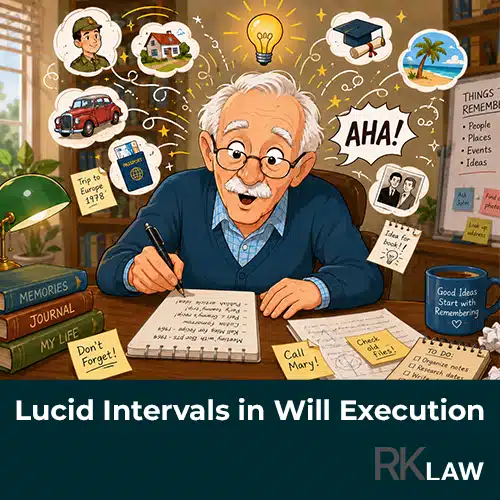
Lucid Intervals in Will Execution: Testamentary Capacity in New York Estate Litigation
Testamentary capacity is one of the most frequently litigated issues in contested probate proceedings. A particularly nuanced aspect is the concept of a “lucid interval”—a period during which a person who may otherwise suffer from cognitive impairment temporarily regains sufficient mental clarity to execute a valid Last Will & Testament. Understanding how Surrogate’s Courts evaluate lucid intervals is critical for handling will contests.
Lucid Intervals in Will Execution – What Is Testamentary Capacity Under New York Law?
In New York, the standard for testamentary capacity is relatively low but precise. At the time the Will is executed, pursuant to E.P.T.L 3-2.1, the testator must:
- Understand the nature and consequences of making a Will
- Know the nature and extent of their property
- Know the natural objects of their bounty (i.e., their heirs and beneficiaries)
This standard is well established in Matter of Kumstar, 66 N.Y.2d 691 (1985), where the Court of Appeals emphasized that capacity must be assessed at the exact moment of execution, not before or after.
The Concept of a Lucid Intervals in Will Execution
A lucid interval refers to a temporary restoration of mental clarity in an individual who otherwise suffers from dementia, mental illness, or cognitive decline. During this interval, the individual may possess the requisite testamentary capacity to execute a valid will.
New York courts recognize lucid intervals as legally sufficient for will execution. Even if a testator has been diagnosed with Alzheimer’s disease or another degenerative condition, a will can still be upheld if credible evidence shows that the execution occurred during a lucid period.
For example, in Matter of Hedges, 100 A.D.2d 586 (2d Dept. 1984), the court upheld a will where testimony established that the decedent experienced moments of clarity despite ongoing mental decline.
When Parties Claim a Lucid Interval in Will Execution During Estate Litigation
In contested probate proceedings, the concept of a lucid interval is often raised strategically by the proponent of the Will to overcome evidence of incapacity. These claims typically arise in fact patterns where the decedent had a documented history of cognitive impairment but executed a will under circumstances suggesting temporary clarity.
Common scenarios include:
Hospital or End-of-Life Execution
A will is executed in a hospital, rehabilitation facility, or hospice setting shortly before death. The contestant points to medical records showing confusion, sedation, or delirium, while the proponent argues that the decedent was alert and oriented at the time of signing. In these cases, testimony from medical staff and the supervising attorney becomes critical.
Diagnosis of Dementia or Alzheimer’s Disease
Where the decedent had a formal diagnosis of dementia, contestants often argue ongoing incapacity. In response, proponents may assert that the decedent had “good days” or periods of lucidity. Courts then examine whether the execution occurred during one of those periods, as contemplated in cases like Matter of Slade, 106 A.D.2d 914 (4th Dept. 1984).
Sudden Change in Testamentary Plan
A new will significantly departs from prior estate plans—for example, disinheriting close family members in favor of a caregiver or distant relative. Contestants argue that the change reflects confusion or undue influence, while proponents claim the decedent clearly articulated rational reasons during a lucid interval.
Fluctuating Mental Capacity
In some cases, medical records and witness accounts show that the decedent’s mental state varied throughout the day. A will executed during a period of alertness—such as in the morning before medication effects—may be defended as occurring during a lucid interval.
Attorney-Supervised Execution with Detailed Inquiry
Where the drafting attorney conducts a thorough capacity assessment and documents the decedent’s responses, proponents frequently rely on this evidence to argue that the decedent was lucid at the time of execution, even if surrounding records suggest impairment.
Burden of Proof in Lucid Interval Cases
The burden of proving testamentary capacity initially rests with the proponent of the will. However, once due execution is established—often through an attorney-supervised ceremony—there is a presumption of capacity.
When a contestant alleges incapacity due to mental illness or dementia, they must rebut this presumption. In lucid interval cases, the focus shifts to whether the testator had capacity at the moment of execution, even if they were generally impaired.
Courts often rely on:
- Testimony from the drafting attorney and attesting witnesses
- Medical records and expert opinions
- Evidence of the testator’s behavior and communications around the time of execution
In Matter of Slade, 106 A.D.2d 914 (4th Dept. 1984), the court noted that even individuals with mental illness can execute valid wills if a lucid interval is demonstrated with credible evidence.
Role of the Drafting Attorney when litigating Lucid Intervals in Will Execution Cases
The drafting attorney plays a pivotal role in establishing testamentary capacity and defending against future challenges. Courts give significant weight to the observations of the attorney who supervised the will execution.
Best practices include:
- Conducting and documenting a thorough capacity assessment
- Asking open-ended questions about assets and family members
- Maintaining detailed notes or memoranda of the execution ceremony
- Considering a contemporaneous medical evaluation in high-risk cases
In Matter of Collins, 60 N.Y.2d 466 (1983), the Court of Appeals highlighted the importance of the attorney’s testimony in establishing both capacity and absence of undue influence.
Litigation Challenges Involving Lucid Intervals in Will Execution
Lucid interval cases are highly fact-specific and often involve conflicting evidence. Common litigation issues include:
Conflicting Medical Evidence
Medical records may show progressive decline, while witnesses testify to moments of clarity. Courts must weigh these competing narratives carefully.
Retrospective Expert Testimony
Experts are often asked to opine on capacity after the fact, sometimes without having examined the decedent. Courts scrutinize such testimony closely.
Credibility of Witnesses
The testimony of attesting witnesses and the drafting attorney can be decisive. Courts evaluate their credibility, consistency, and level of detail.
Timing of Execution
Even minor discrepancies in timing can be critical. The key question remains: Did the testator have capacity at the precise moment the will was signed?
Frequently Asked Questions about Lucid Intervals in Will Execution
Yes. A diagnosis of dementia does not automatically invalidate a will. New York courts recognize that individuals with cognitive impairments may still have lucid intervals during which they possess testamentary capacity. If it can be shown that the will was executed during such a period of clarity—meeting the standards outlined in cases like Matter of Kumstar—the will may be admitted to probate.
A lucid interval is a temporary period during which a person suffering from dementia, mental illness, delirium, or cognitive impairment regains sufficient mental clarity to understand and execute a valid will. Under New York law, a will executed during a lucid interval may still be admitted to probate if the testator possessed testamentary capacity at the precise moment of signing.
Initially, the burden falls on the proponent of the will to establish due execution and testamentary capacity. However, when a will is drafted and supervised by an attorney, New York courts generally apply a presumption of capacity. The burden then shifts to the contestant to present evidence of incapacity or undue influence.
Yes. Many probate contests involve both claims simultaneously. A contestant may argue that the decedent lacked capacity and was also susceptible to manipulation by a beneficiary or caregiver.
Even where capacity exists during a lucid interval, a will can still be invalidated if undue influence is proven.
No. Testamentary capacity requires a lower level of mental functioning than contractual capacity. A person may be incapable of managing complex financial affairs yet still possess sufficient capacity to execute a valid will.
New York courts recognize that making a will is a comparatively simple legal act.
Final Thoughts on Lucid Intervals in Will Execution
For more information, please contact NYC Probate Litigation, Guardianship, Probate, and Estate Planning attorney Regina Kiperman:

Phone: 917-261-4514
Fax: 929-556-2089
Email: rkiperman@rklawny.com
Or visit her at:
40 Wall Street
Suite 2508
New York, NY 10005
Visit Regina on LinkedIn
Visit Regina on Facebook
This page is made available by the lawyer for educational purposes only as well as to give you general information and a general understanding of the law, not to provide specific legal advice. By using this site you understand that there is no attorney client relationship between you and the lawyer. The post should not be used as a substitute for competent legal advice from a licensed professional attorney in your state. ATTORNEY ADVERTISING.