
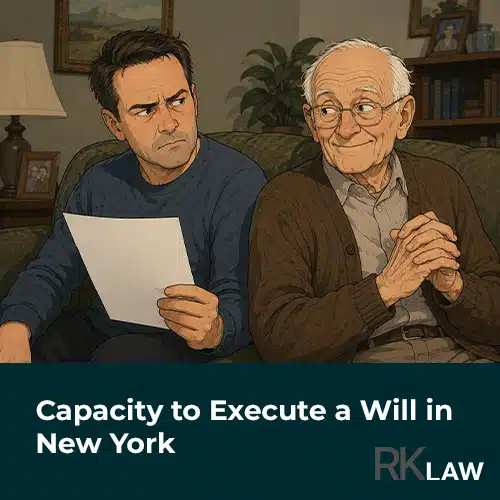
Capacity to Execute a Will in New York: Testamentary Capacity, Undue Influence, and Probate Challenges
When a loved one changes a Will late in life, disinherits close family members, or leaves substantial assets to caregivers or new acquaintances, surviving family members often question whether the document truly reflects the decedent’s wishes. In New York probate litigation, two of the most common grounds to challenge a will are lack of testamentary capacity and undue influence. These claims frequently overlap because a person with diminished mental or physical health may still possess legal capacity while also being vulnerable to pressure or manipulation.
New York probate litigation attorneys regularly represent executors, beneficiaries, and objectants in contested probate proceedings involving allegations of incapacity, undue influence, fraud, and improper execution. Understanding how New York courts analyze these claims is critical for anyone involved in a Surrogate’s Court dispute.
What Is Testamentary Capacity or Capacity to Execute a Will in New York?
Under New York law, a person must be at least 18 years old and of “sound mind and memory” to execute a valid will pursuant to EPTL § 3-1.1. Testamentary capacity refers to the legal ability of the testator to understand the nature and consequences of making a will at the time the document is signed.
To satisfy this standard, the testator must generally understand that they are executing a will, recognize the nature and extent of their property, and know the individuals who would ordinarily be expected to inherit from them. New York courts consistently emphasize that the standard for testamentary capacity is relatively low.
A person may suffer from illness, dementia, advanced age, or memory problems and still possess sufficient legal capacity to execute a valid will.
The key inquiry is always the testator’s condition at the exact moment of execution. Even individuals diagnosed with Alzheimer’s disease or cognitive decline may execute valid wills during lucid intervals in which they fully understand the transaction.
Key New York Testamentary Capacity Cases
New York courts have repeatedly addressed testamentary capacity in probate litigation. In Matter of Kumstar, 66 N.Y.2d 691 (1985), the New York Court of Appeals explained that old age, physical weakness, or mental decline do not automatically invalidate a will. The court held that the proper inquiry focuses on whether the decedent understood the nature of executing the will at the time it was signed.
Similarly, in Matter of Slade, 106 A.D.2d 914 (4th Dep’t 1984), the court articulated the familiar three-part standard requiring the testator to understand the act of making a will, the nature of their assets, and the natural beneficiaries of their estate.
In Matter of Hedges, 100 A.D.2d 586 (2d Dep’t 1984), the court further clarified that senility or dementia alone is insufficient to invalidate a will unless the condition affected the decedent’s understanding during execution.
These decisions demonstrate that New York courts focus heavily on contemporaneous evidence concerning the decedent’s mental condition during the will signing ceremony itself.
What Is Undue Influence in New York Will Contests?
Undue influence is a separate legal theory from testamentary capacity, although the two claims are frequently litigated together. While testamentary capacity concerns the testator’s mental ability, undue influence examines whether another individual improperly pressured or manipulated the testator into executing a will that does not reflect their true wishes.
New York courts define undue influence as conduct amounting to moral coercion that restrains independent action and destroys free agency. Because undue influence typically occurs behind closed doors, direct evidence is rare. Courts therefore permit undue influence to be established through circumstantial evidence and reasonable inferences drawn from the surrounding facts.
Claims of undue influence often arise where a vulnerable elderly individual becomes dependent upon a caregiver, relative, or advisor who later benefits substantially under the will. Courts may closely scrutinize situations where family members are excluded, longstanding estate plans are suddenly changed, or the beneficiary played a significant role in arranging the estate planning process.
Common Signs of Undue Influence
In probate litigation, courts examine the totality of the circumstances surrounding the will’s execution. Suspicious circumstances may include a beneficiary isolating the decedent from family members, controlling access to finances or medications, selecting the attorney who drafts the will, or participating heavily in the preparation and execution of the estate documents.
Courts also consider whether the decedent was physically weakened, cognitively impaired, emotionally dependent, or susceptible to manipulation. A sudden or unexplained departure from prior estate plans may further support allegations of undue influence, particularly when the new will disproportionately benefits a caregiver or person in a position of trust.
No single fact automatically establishes undue influence. Instead, Surrogate’s Courts analyze whether the overall evidence demonstrates that the decedent’s free will was overcome.
Burden of Proof in New York Probate Litigation and Capacity to Execute a Will in New York
In New York probate proceedings, the person offering the Will for probate initially bears the burden of proving due execution and testamentary capacity. This burden is often satisfied through the testimony of the drafting attorney and attesting witnesses, as well as the use of attestation clauses and self-proving affidavits executed at the time of signing.
Once the will proponent establishes a prima facie case, the burden generally shifts to the objectant challenging the will. The objectant must then present evidence supporting claims such as lack of testamentary capacity, undue influence, fraud, or duress.
Although New York law presumes that competent adults possess capacity, that presumption may be challenged through medical records, witness testimony, expert opinions, and evidence concerning the circumstances surrounding execution.
Burden Shifting in Undue Influence Cases
Undue influence cases involve important burden-shifting principles that can significantly affect probate litigation. Ordinarily, the objectant bears the burden of proving undue influence. However, courts may shift the burden where a confidential or fiduciary relationship existed between the decedent and the beneficiary and suspicious circumstances surround the preparation or execution of the will.
Confidential relationships frequently arise between elderly individuals and caregivers, attorneys, financial advisors, guardians, or agents acting under powers of attorney. When the beneficiary occupies a position of trust and actively participates in procuring the will while receiving a substantial benefit, courts may require the beneficiary to explain the transaction and demonstrate that the will was free from undue influence.
This burden-shifting framework is particularly important in cases involving isolation, dependency, or substantial deviations from prior estate plans.
Important New York Undue Influence Cases
One of the leading New York cases addressing undue influence is Matter of Walther, 6 N.Y.2d 49 (1959). In that case, the Court of Appeals explained that undue influence must amount to moral coercion that destroys independent judgment and free will. The court acknowledged that undue influence is rarely proven by direct evidence and may instead be inferred from circumstantial facts.
In Matter of Neenan, 35 A.D.3d 475 (2d Dep’t 2006), the court held that motive, opportunity, and the actual exercise of influence may collectively support an inference of undue influence sufficient to sustain objections to probate.
Likewise, in Matter of Burke, 82 A.D.3d 774 (2d Dep’t 2011), the court found that evidence of dependency, isolation, and beneficiary involvement in estate planning supported undue influence claims sufficient to survive dismissal.
These decisions illustrate how New York courts evaluate relationships, vulnerability, and suspicious conduct when determining whether a will reflects the decedent’s independent intentions.
Testamentary Capacity and Undue Influence Often Overlap
Although legally distinct, testamentary capacity and undue influence frequently intersect in probate litigation. A person with mild dementia may still understand the nature of executing a will and therefore possess testamentary capacity. However, that same cognitive impairment may render the individual especially vulnerable to pressure or manipulation by caregivers or family members.
As a result, courts often consider evidence of mental decline, dependency, medication use, social isolation, and emotional vulnerability when evaluating undue influence claims. Even where capacity exists, substantial evidence of manipulation or coercion may still invalidate the will.
Evidence Commonly Used in Will Contests and Capacity to Execute a Will in New York
Probate litigation involving testamentary capacity and undue influence is highly fact-intensive and requires production and exchange of evidence Courts frequently review medical records, neurology evaluations, hospital records, caregiver notes, financial documents, emails, text messages, and testimony from attorneys, witnesses, and family members.
The drafting attorney’s testimony is often particularly important because the attorney can describe the decedent’s mental condition, reasoning, and independence during the estate planning process. Prior wills and longstanding estate plans may also become significant evidence when evaluating sudden changes in testamentary intent.
In some cases, parties retain medical experts to review records and opine on whether the decedent likely possessed capacity or susceptibility to undue influence at the relevant time.
Capacity to Execute a Will in New York Frequently Asked Questions
Testamentary capacity means the person signing the will understood that they were making a will, knew the general nature of their assets, and recognized the individuals who would ordinarily inherit from their estate.
Undue influence occurs when another individual exerts pressure or manipulation that destroys the testator’s free will and causes execution of a will that does not reflect the testator’s independent wishes.
Generally, the objectant challenging the will bears the burden of proof. However, courts may shift the burden where confidential relationships and suspicious circumstances exist.
Yes. Dementia alone does not invalidate a will. New York courts focus on whether the person understood the will at the specific time it was executed.
Caregivers often occupy positions of trust and may exercise substantial influence over vulnerable individuals. Courts carefully examine situations where caregivers receive significant benefits under a will.
Contact RK Law For Questions Regarding Capacity to Execute a Will in New York
Will contests involving testamentary capacity and undue influence often require extensive discovery, medical evidence, witness testimony, and detailed analysis of family dynamics. At RK Law, we represent clients in contested probate proceedings, fiduciary litigation, guardianship matters, and estate disputes throughout New York Surrogate’s Courts.
To learn more about probate litigation and estate disputes, visit www.rklawny.com.
For more information, please contact NYC Probate Litigation, Guardianship, Probate, and Estate Planning attorney Regina Kiperman:

Phone: 917-261-4514
Fax: 929-556-2089
Email: rkiperman@rklawny.com
Or visit her at:
40 Wall Street
Suite 2508
New York, NY 10005
Visit Regina on LinkedIn
Visit Regina on Facebook
This page is made available by the lawyer for educational purposes only as well as to give you general information and a general understanding of the law, not to provide specific legal advice. By using this site you understand that there is no attorney client relationship between you and the lawyer. The post should not be used as a substitute for competent legal advice from a licensed professional attorney in your state. ATTORNEY ADVERTISING.