
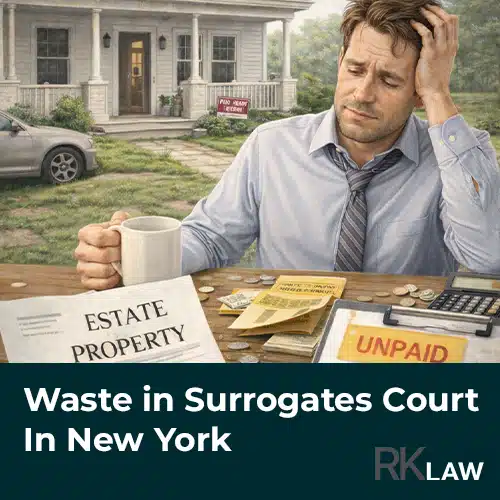
Waste in Surrogates Court in New York: When Executor Mismanagement Becomes Grounds for Removal
In New York probate proceedings, “waste” is more than a beneficiary’s frustration with delays. In Surrogate’s Court, waste describes improvident management, neglect, or misconduct that harms (or threatens to harm) estate property. When an executor’s actions—or inaction—cause estate assets to deteriorate, incur avoidable penalties, or lose value, beneficiaries may seek relief, including suspension, removal, and financial reimbursement (surcharge).
At RK Law PC, we represent beneficiaries and fiduciaries in Surrogate’s Court disputes involving executor misconduct, failure to account, estate mismanagement, and fiduciary litigation. We assist with cases involving Waste in Surrogates Court in New York.
What Does Waste in Surrogates Court mean in an Estate Administration?
In probate terms, waste refers to conduct showing that a fiduciary has mismanaged, neglected, or injured estate property, or has behaved in a way that makes them unfit to continue as executor. Waste can be:
- Active (bad decisions, reckless spending, unnecessary litigation), or
- Passive (neglect, failure to insure property, failure to address taxes, failure to safeguard assets).
Either way, the central issue is the same: estate value is being diminished—sometimes irreversibly.
Common examples of Waste in Surrogates Court
1) Neglecting estate real property
Real estate is often an estate’s biggest asset—and also the easiest to “waste” through inattention. Examples include:
- Letting homeowner’s insurance lapse
- Failing to winterize or secure the property
- Ignoring leaks, mold, code violations, or unsafe conditions
- Allowing tenant issues to fester without action
- Failing to pay carrying costs (taxes, utilities, HOA charges), leading to liens, penalties, or foreclosure risk
When a home’s condition declines because the executor didn’t act reasonably, the resulting loss can support court intervention.
2) Tax deadlines, interest, and penalties that didn’t need to happen
Executors are expected to handle tax compliance responsibly. Waste issues commonly involve:
- Missing fiduciary income tax filings
- Ignoring estate tax deadlines when applicable
- Allowing avoidable interest and penalties to accrue
- Failing to address notices, liens, or payment plans in time
Courts often view unnecessary penalties as a preventable drain on beneficiaries.
3) “Bleeding the estate” through pointless spending or bad-faith litigation
Executors can spend estate funds on legitimate administrative expenses, but those expenses must be reasonable and tied to the executor’s duties. Red flags include:
- Spending heavily on litigation that does not benefit the estate
- Hiring professionals unnecessarily or duplicating services
- Pursuing personal vendettas using estate money
- Generating fees while the estate remains stagnant
4) Mishandling funds or creating financial risk
Even without outright theft, an executor can expose the estate to danger by:
- Commingling estate funds with personal funds
- Using improper accounts (or no estate account at all)
- Failing to maintain adequate records
- Making distributions without a clear plan for liabilities and expenses
Poor recordkeeping and money handling often leads to deeper court scrutiny—especially when beneficiaries ask, “Where did the money go?”
Case law examples:
New York courts often start with an important principle: they respect the decedent’s choice of executor. Removal is considered a major remedy. But courts will intervene when the record shows that the executor’s behavior has crossed the line into unfitness, mismanagement, or injury to estate property.
In removal cases, judges tend to focus on:
- Documented financial harm (penalties, liens, lost value)
- Ongoing risk (property deterioration, unpaid obligations)
- Inability or refusal to perform basic duties
- Breakdown in administration that prevents the estate from moving forward
- Failure to provide transparency (missing records, refusal to account)
FAQ: Removing an Executor for Waste in Surrogates Court
The best cases are built on documents and objective evidence, such as:
Photos, inspection reports, repair estimates
Property tax bills, delinquency notices, or lien documents
Insurance cancellation notices
Bank statements and transaction histories
Appraisals or comparative market analyses
Proof of penalties and interest tied to missed deadlines
Correspondence showing refusal to act or refusal to provide information
Usually, no. Personality conflicts and hostility alone typically are not enough. But if conflict leads to administrative paralysis or financial loss, it can become relevant—especially if the executor is failing to protect estate assets.
A surcharge is a financial remedy. If the court finds the executor’s misconduct or negligence caused loss, the executor may be ordered to repay the estate personally for the damage.
It depends on the facts. Removal can take time if a full hearing is needed. However, where there is immediate danger—such as property deterioration, unpaid taxes, or missing funds—your attorney may request temporary protections to prevent further loss while the case is pending.
How RK Law PC Can Help with Waste in Surrogates Court
When you suspect “waste,” the goal is to stop further loss and create a record the court can act on. RK Law PC can help by:
- Assessing risk quickly: Identifying urgent threats like lapsed insurance, delinquent taxes, property neglect, or suspicious transfers.
- Demanding transparency: Preparing written demands for records, banking information, and status updates—so the executor’s actions (or inaction) are documented.
- Compelling an accounting: Seeking court orders that require the executor to explain where the money went and provide supporting documentation.
- Seeking protective relief: Requesting temporary restrictions, turnover relief, or other safeguards to prevent the estate from being depleted while litigation is pending.
- Pursuing removal and surcharge: Filing petitions to remove or suspend an executor when appropriate, and seeking reimbursement when losses were preventable.
- Guiding next-step administration: Helping move the estate forward after court intervention—whether through a successor fiduciary, structured sale of property, or court-supervised distributions.
Don’t wait until the money is gone
If you suspect an executor is wasting estate assets, delay can be costly. Property damage grows, penalties accrue, and recoveries become harder. Early legal action can preserve what the decedent intended to pass on.
Contact RK Law PC to discuss your options and how to protect estate assets in New York Surrogate’s Court.
For more information, please contact NYC Probate Litigation, Guardianship, Probate, and Estate Planning attorney Regina Kiperman:

Phone: 917-261-4514
Fax: 929-556-2089
Email: rkiperman@rklawny.com
Or visit her at:
40 Wall Street
Suite 2508
New York, NY 10005
Visit Regina on LinkedIn
Visit Regina on Facebook
This page is made available by the lawyer for educational purposes only as well as to give you general information and a general understanding of the law, not to provide specific legal advice. By using this site you understand that there is no attorney client relationship between you and the lawyer. The post should not be used as a substitute for competent legal advice from a licensed professional attorney in your state. ATTORNEY ADVERTISING.