
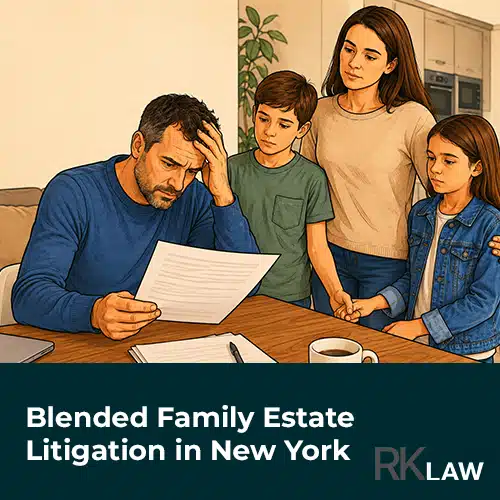
Blended Family Estate Litigation in New York
Blended families often face estate disputes involving Wills, trusts, surviving spouses, and children from prior marriages. Learn why blended family estate litigation is common in New York and how courts handle these inheritance conflicts.
Understanding Why Blended Family Estate Litigation Is So Common
Blended families are increasingly common in New York, but they also create some of the most emotionally charged and legally complex estate disputes. When spouses enter a marriage with children from prior relationships, separate financial obligations, and different expectations about inheritance, the potential for conflict after death rises dramatically.
At RK Law PC, we regularly see blended family estate litigation arise when estate plans fail to account for the unique dynamics of second marriages and stepfamily relationships.
Careful planning can reduce disputes, but when planning is incomplete, outdated, or unclear, surviving spouses and children often end up in Surrogate’s Court fighting over assets, fiduciary conduct, and the true intentions of the deceased.
Unequal Inheritances Frequently Lead to Estate Disputes
One of the most common causes of blended family estate litigation is unequal treatment among children.
A parent may intend to provide more generously for children from a first marriage while still supporting a current spouse. Alternatively, a surviving spouse may believe that marital assets should pass entirely to them, while children from a prior relationship expect to inherit a portion immediately.
These conflicting expectations frequently lead to Will contests, objections to trusts, and claims of undue influence.
New York courts regularly address these disputes. In Matter of Walker, the decedent changed his estate plan late in life to significantly benefit one child over others after remarrying. The disinherited children challenged the will, alleging undue influence and lack of capacity. The case demonstrated how sudden changes to estate planning documents in blended family situations often lead to litigation, especially when one side believes another family member manipulated the Decedent.
Beneficiary Designations Often Conflict With Estate Plans
Second marriages often complicate ownership of property and beneficiary designations. Assets such as retirement accounts, life insurance policies, jointly held bank accounts, and real estate may pass outside the will entirely. If beneficiary forms are outdated or inconsistent with the estate plan, litigation can arise over who was intended to receive the assets.
For example, in Matter of Urciuoli, disputes arose over beneficiary designations and jointly held assets following remarriage. The court examined whether certain transfers reflected the true intent of the decedent or improperly excluded family members from inheritance. Cases like these highlight how failing to update financial documents after remarriage can unintentionally disinherit children from prior relationships.
Executors and Trustees in Blended Families Face Increased Scrutiny
Blended family estate litigation also commonly arises when a surviving spouse serves as executor or trustee. Children from a prior marriage may question whether the fiduciary is acting fairly, especially if they believe estate assets are being withheld, mismanaged, or distributed improperly. Fiduciary misconduct claims are common in these situations, including allegations of self-dealing, failure to account, improper transfers, and concealment of estate property.
In Matter of Duke, beneficiaries challenged the actions of a fiduciary who allegedly favored one side of the blended family over another during estate administration. The litigation involved disputes regarding financial transparency and the handling of estate assets. These cases illustrate how quickly mistrust can develop when family members already have strained relationships before the decedent’s death.
Verbal Promises Create Conflicts After Death
Another significant issue involves promises that were never formally documented. In blended families, individuals frequently make verbal assurances about inheritance, such as promising children they will eventually inherit a family home or assuring a spouse that they will be financially protected for life. If these promises are not properly memorialized in wills, trusts, or prenuptial agreements, disputes arise after death when beneficiaries discover the estate plan says something entirely different.
Courts in New York rely heavily on written legal documents, not informal family understandings. In many estate disputes, disappointed beneficiaries claim the decedent “promised” them property or financial support, only to discover that the executed estate documents provide otherwise. This disconnect between expectations and legal documentation is one of the driving forces behind blended family estate litigation.
Trust Disputes Are Common in Blended Families
Trusts are commonly used in blended family estate planning, but even trusts can become sources of litigation if they are ambiguous or poorly administered. A common strategy involves leaving assets in trust for a surviving spouse during their lifetime, with the remainder eventually passing to children from a prior marriage. Problems occur when the trustee has broad discretion over distributions or when beneficiaries disagree about how trust assets are being used.
In Matter of Hyman, disputes arose between a surviving spouse and remainder beneficiaries over trust administration and the use of trust assets. Cases like this demonstrate the importance of carefully drafted trust provisions that clearly define the rights of spouses, children, and trustees in blended family arrangements.
Emotional Family Dynamics Intensify Estate Litigation
Estate litigation involving blended families is particularly difficult because the disputes are deeply personal. Longstanding family tensions, sibling rivalries, and resentment between stepchildren and stepparents often intensify after the death of a loved one. Financial issues become intertwined with emotional
Proper Estate Planning Can Reduce Blended Family Estate Litigation
Proper estate planning can significantly reduce the risk of blended family estate litigation. Clear wills and trusts, updated beneficiary designations, prenuptial or postnuptial agreements, and open communication with family members can help avoid future disputes. Estate plans should also be reviewed regularly after remarriage, divorce, births, deaths, or significant financial changes.
Frequently Asked Questions About Blended Family Estate Litigation
Blended families frequently involve competing interests between surviving spouses, children from prior marriages, and stepchildren. Disputes often arise over inheritance rights, unequal distributions, beneficiary designations, and allegations of undue influence.
Yes. Children may challenge a will based on lack of capacity, undue influence, fraud, improper execution, or other legal grounds. These disputes are handled in New York Surrogate’s Court.
Beneficiary designations on accounts such as life insurance and retirement plans generally control, even if the will says something different. This is why updating all estate planning documents is critical after remarriage.
Depending on how assets are titled and how the estate plan is structured, children from a prior marriage may receive less than expected. However, litigation may arise if there are concerns about improper transfers, undue influence, or fiduciary misconduct.
Many blended families use trusts to provide income or support to a surviving spouse while preserving assets for children from a prior relationship. Proper drafting is essential to avoid future disputes.
Clear estate planning documents, updated beneficiary forms, prenuptial agreements, transparent communication, and regular reviews of the estate plan can help minimize litigation risks.
Common cases include will contests, trust disputes, contested accountings, fiduciary removal proceedings, turnover proceedings, and disputes involving jointly owned property or beneficiary designations.
Blended family estate disputes are legally and emotionally complex. An experienced estate litigation attorney can protect your rights, investigate fiduciary conduct, and represent your interests in Surrogate’s Court proceedings throughout New York.
When conflicts arise, experienced estate litigation counsel is essential to protect beneficiaries, executors, trustees, and surviving spouses in Surrogate’s Court proceedings.
RK Law PC represents clients throughout New York in contested probate proceedings, trust disputes, fiduciary litigation, accounting proceedings, and inheritance disputes involving blended families. Whether you are seeking to challenge an estate plan or defend your rights as a fiduciary or beneficiary, our firm provides experienced representation tailored to complex family and financial situations.
For more information, please contact NYC Probate Litigation, Guardianship, Probate, and Estate Planning attorney Regina Kiperman:

Phone: 917-261-4514
Fax: 929-556-2089
Email: rkiperman@rklawny.com
Or visit her at:
40 Wall Street
Suite 2508
New York, NY 10005
Visit Regina on LinkedIn
Visit Regina on Facebook
This page is made available by the lawyer for educational purposes only as well as to give you general information and a general understanding of the law, not to provide specific legal advice. By using this site you understand that there is no attorney client relationship between you and the lawyer. The post should not be used as a substitute for competent legal advice from a licensed professional attorney in your state. ATTORNEY ADVERTISING.