
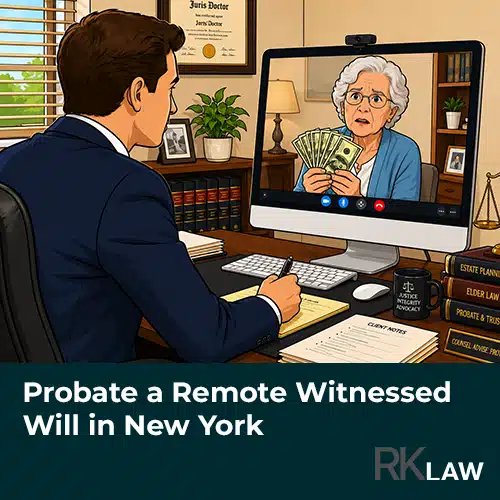
Do you know how to Probate a Remote Witnessed Will in New York?
During the COVID-19 pandemic, many New Yorkers signed estate planning documents under unusual circumstances. Hospitals, nursing homes, assisted living facilities, and private homes often had strict visitor limitations. Families could not always gather in person. Attorneys had to supervise signings over Zoom, FaceTime, Microsoft Teams, or other video platforms. Witnesses sometimes watched a will signing remotely rather than standing in the same room as the person signing the will.
Years later, those wills are now being offered for probate in New York Surrogate’s Courts. This has created a new category of probate disputes: remote-witnessed wills and COVID-era will contests. The key question when we try to probate a remote witnessed Will is whether the will was executed in compliance with the temporary pandemic rules and New York’s traditional will execution requirements.
What Is a Remote Witnessed Will?
A remote-witnessed will is a will that was signed while one or more witnesses observed the signing through audio-video technology rather than in person.
During the pandemic, remote witnessing became a practical solution for people who needed estate planning documents but could not safely meet with attorneys and witnesses in the same physical location. In New York, Executive Order 202.14 temporarily permitted remote witnessing of certain documents, including wills, beginning in April 2020. The remote-witnessing authorization was tied to emergency pandemic measures and was not a permanent replacement for ordinary will execution rules.
New York’s Traditional Will Execution Requirements Still Matter When You Probate a Remote Witnessed Will.
New York wills are governed by EPTL 3-2.1. In general, a New York will must be in writing, signed by the testator at the end, and witnessed by at least two witnesses. The testator must also publish the will, meaning the testator must communicate to the witnesses that the document is their will.
Remote witnessing did not eliminate the importance of those formalities. Instead, the temporary emergency rules created a way for certain witnessing requirements to be satisfied by video conference if specific procedures were followed.
That means a COVID-era remote-witnessed will may raise questions such as:
- Did the testator sign the will during a real-time video conference?
- Could the witnesses see the testator sign?
- Did the testator display valid photo identification, if required?
- Did the testator affirmatively state that the document was their will?
- Were the witnesses located in New York or otherwise authorized to serve?
- Were the original signature pages transmitted to the witnesses as required?
- Did the witnesses sign the correct document?
- Were the required steps completed within the required time?
- Does the attorney-drafter’s file document the remote execution ceremony?
If the answer to one or more of these questions is unclear, the will may become the subject of probate objections.
How to Probate a Remote Witnessed in New York?
Yes, you can probate a remote witnessed Will if the Surrogate’s Court is satisfied that the Will was validly executed.
Surrogate’s Courts have addressed COVID-era remote will executions on a case-by-case basis. A remote-witnessed will may be accepted where the court finds that the testator signed the will, properly declared it to be a will, requested that the witnesses serve as witnesses, and complied with the temporary remote-witnessing rules.
However, not every remote-witnessed will is automatically valid. Courts may closely examine whether the remote execution complied with Executive Order 202.14 and New York’s traditional will formalities under EPTL 3-2.1. The executive order did not replace New York will execution law. It temporarily allowed certain witnessing acts to occur remotely if specific procedural requirements were satisfied.
The lesson is simple: a remote-witnessed will can be probated, but the details matter.
Why COVID-Era Wills Are Vulnerable to Probate Objections
Remote will executions often happened during stressful and urgent circumstances. Many testators were elderly, hospitalized, isolated, or facing serious medical issues. Attorneys and witnesses were sometimes dealing with new procedures in real time. Families may not have been present. Technology problems, unclear video quality, incomplete records, or confusion about the required process may now create litigation issues.
Potential probate objections may include:
- Improper execution
- Lack of testamentary capacity
- Undue influence
- Fraud
- Duress
- Lack of knowledge of the contents of the will
- Failure to comply with Executive Order 202.14
- Failure to comply with EPTL 3-2.1
- Questions about the authenticity of signature pages
- Questions about whether witnesses actually observed the signing
These issues are especially important when the remote-witnessed will changed the decedent’s estate plan, excluded close family members, favored a caregiver or one child, or was signed shortly before death.
Common Red Flags When You Probate A Remote Witnessed Will
A remote-witnessed will may deserve closer review if there are red flags surrounding the signing ceremony or the estate plan.
Common red flags include:
- The will was signed while the decedent was hospitalized or seriously ill
- The will was signed in a nursing home or assisted living facility during visitor restrictions
- The will was a major departure from a prior will
- One beneficiary arranged the attorney meeting
- One beneficiary controlled the technology or video conference
- The testator appeared confused, medicated, or unable to communicate clearly
- The witnesses did not know the testator
- The attorney did not meet privately with the testator
- The original document and witness signature pages were not handled properly
- The self-proving affidavit does not explain the remote signing process
- There is no video recording, detailed attorney memo, or clear execution checklist
- Family members were excluded from contact before or after the will signing
The existence of a red flag does not automatically invalidate a will. But red flags may justify SCPA 1404 discovery or formal objections to probate.
SCPA 1404 Discovery When You Probate a Remote Witnessed Will
Before filing objections to probate, an interested party may be able to conduct SCPA 1404 examinations. This is an important discovery tool in New York Surrogate’s Court.
In a remote-witnessed will case, SCPA 1404 discovery may focus on:
- The attorney who drafted or supervised the will
- The attesting witnesses
- The nominated executor
- The circumstances of the video conference
- The attorney’s notes and execution checklist
- Emails transmitting the will or signature pages
- The self-proving affidavit
- Drafts of the will
- Prior wills
- Medical records
- Communications among beneficiaries, the attorney, and the decedent
SCPA 1404 discovery can help determine whether there is a good-faith basis to file objections. It can also help identify whether the remote execution was carefully documented or whether there are gaps in the proof.
What Evidence Matters in a Will Contest When You Probate a Remote Witnessed Will?
Remote-witnessed will disputes often depend on documentary evidence and witness testimony.
Important evidence may include:
- The original will
- Witness affidavits
- The self-proving affidavit
- Attorney-drafter notes
- Emails between the attorney, witnesses, and client
- Video conference invitations or logs
- Delivery records for signature pages
- Scanned copies of signed documents
- Medical records near the date of execution
- Prior estate planning documents
- Text messages or emails from beneficiaries
- Notes showing who was present during the video conference
- Records showing whether the decedent was isolated or dependent on another person
Because remote execution procedures were unusual, good recordkeeping can be critical. If the attorney’s file clearly documents the process, probate may be easier. If the file is incomplete, objectants may have more room to challenge the Will.
Improper Execution Objections When You Probate a Remote Witnessed Will
Improper execution is one of the most direct objections in a remote-witnessed will case.
An objectant may argue that:
- The testator did not sign the will properly
- The witnesses did not observe the signing
- The testator did not declare the document to be a will
- The witnesses signed the wrong document
- The original signature pages were not properly presented
- The required timeline was not followed
- The self-proving affidavit is incomplete or inaccurate
New York courts generally take will formalities seriously. A will is not valid merely because it reflects the decedent’s general wishes. It must be executed in the manner required by law.
Capacity Issues in COVID-Era Will Contests
Many remote-witnessed Wills were signed when the testator was ill, isolated, or receiving medical care. This can raise questions about testamentary capacity.
A lack of capacity objection may focus on whether the testator understood:
- That they were signing a will
- The nature and extent of their property
- The natural objects of their bounty, such as close family members
- The disposition being made under the will
Medical records are often important in these cases. Records from hospitals, nursing homes, doctors, psychiatrists, neurologists, home health aides, or assisted living facilities may show whether the testator was alert, oriented, confused, medicated, or cognitively impaired near the time of execution.
A diagnosis alone does not necessarily prove lack of capacity. The question is usually whether the testator had the required capacity at the time the will was signed.
Undue Influence Issues When You Probate a Remote Witnessed Will
Remote signings may also raise undue influence concerns. During the pandemic, many older adults depended heavily on one person for transportation, groceries, medical care, communication, and access to technology. That dependence can become relevant when the same person benefits from a new will.
An undue influence claim may examine:
- Who contacted the attorney
- Who arranged the video conference
- Who was physically present with the testator
- Who controlled the computer, tablet, or phone
- Whether the attorney spoke privately with the testator
- Whether the testator was isolated from other family members
- Whether the will favored the person who controlled access
- Whether there were sudden changes to prior estate plans
Undue influence is often proven through circumstantial evidence. In remote-witnessed will cases, the details of who controlled the process can be especially important.
Does Remote Notarization Make a Will Valid?
Not necessarily. A New York will is not valid simply because it was notarized. Wills require proper execution and attestation under the Estates, Powers and Trusts Law.
A self-proving affidavit may help prove a will, but it does not cure every defect in execution. In a COVID-era remote-witnessed will case, the affidavit may need to explain how the signing occurred and whether the required remote-witnessing procedures were followed.
Families should not assume that a notarized document is automatically a valid will.
What Should You Do If You Are Concerned About How To Probate a Remote Witnessed Will?
If a will was signed remotely during the pandemic and you are concerned about its validity, you should act quickly. Probate proceedings are deadline-driven, and the time to demand discovery or file objections may be limited.
Potential next steps include:
- Review the probate petition and citation
- Request a copy of the will and self-proving affidavit
- Determine whether the will was signed during the Executive Order 202.14 period
- Examine whether the will changed a prior estate plan
- Consider SCPA 1404 examinations
- Seek attorney-drafter records
- Review medical records near the date of execution
- Investigate whether any beneficiary controlled the signing process
A remote-witnessed will may be valid. But if the facts are unclear, discovery may be necessary before deciding whether to object.
Frequently Asked Questions About How to Probate a Remote-Witnessed Will in New York
Yes. A remote-witnessed will may be admitted to probate in New York if the Surrogate’s Court finds that the will was validly executed. For COVID-era wills, the court may review whether the signing complied with New York’s temporary remote-witnessing rules and the traditional will execution requirements under EPTL 3-2.1.
A remote-witnessed will is a will that was signed while one or more witnesses observed the signing by video conference rather than being physically present in the same room. During the COVID-19 pandemic, New York temporarily allowed remote witnessing under emergency rules if specific procedures were followed.
No. A COVID-era remote-witnessed will is not automatically valid. The person offering the will for probate may need to show that the signing complied with the applicable executive order, New York will execution formalities, and any required procedures for witnessing, transmission, and attestation.
Yes. A will signed over Zoom or another video platform may be challenged if there are questions about improper execution, lack of testamentary capacity, undue influence, fraud, duress, or failure to comply with the COVID-era remote-witnessing rules.
Common objections to a remote-witnessed will include improper execution, lack of capacity, undue influence, fraud, duress, lack of knowledge of the contents of the will, and failure to follow the required remote-witnessing procedures.
Important evidence may include the original will, witness affidavits, the self-proving affidavit, attorney notes, emails, video conference records, delivery records for signature pages, medical records, prior wills, and testimony from the attorney, witnesses, beneficiaries, and caregivers.
SCPA 1404 discovery allows certain interested parties to examine witnesses and request documents before deciding whether to file objections to probate. In a remote-witnessed will case, SCPA 1404 discovery may focus on the attorney-drafter, attesting witnesses, video conference procedures, emails, signature pages, and the decedent’s capacity.
No. A notarized document is not automatically a valid will in New York. A will must satisfy New York’s execution and attestation requirements. A self-proving affidavit may help prove the will, but it does not necessarily cure every defect in the signing process.
Many COVID-era wills are being offered for probate years after they were signed. Families may now be questioning whether the will was properly executed, whether the decedent had capacity, whether someone exercised undue influence, or whether the remote-witnessing procedures were followed.
RK Law Represents Clients in New York Will Contests and Probate Objections and Can Help Probate a Remote Witnessed Will
COVID-era wills present unique issues in New York Surrogate’s Court. A remote-witnessed will may be admitted to probate, but only if the proponent can establish that the Will was validly executed and that the required procedures were followed.
RK Law represents beneficiaries, distributees, fiduciaries, and interested parties in New York Surrogate’s Court proceedings, including will contests, probate objections, SCPA 1404 examinations, undue influence claims, lack of capacity claims, contested accountings, turnover proceedings, joint account disputes, and beneficiary designation disputes.
If you have questions about how to probate a remote witnessed Will, COVID-era estate plan, virtual will signing, or probate objection in New York, contact RK Law to discuss your options.
For more information, please contact NYC Probate Litigation, Guardianship, Probate, and Estate Planning attorney Regina Kiperman:

Phone: 917-261-4514
Fax: 929-556-2089
Email: rkiperman@rklawny.com
Or visit her at:
40 Wall Street
Suite 2508
New York, NY 10005
Visit Regina on LinkedIn
Visit Regina on Facebook
This page is made available by the lawyer for educational purposes only as well as to give you general information and a general understanding of the law, not to provide specific legal advice. By using this site you understand that there is no attorney client relationship between you and the lawyer. The post should not be used as a substitute for competent legal advice from a licensed professional attorney in your state. ATTORNEY ADVERTISING.