
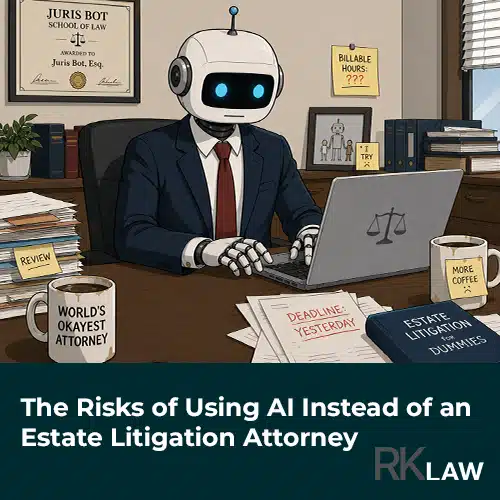
The Risks of Using AI Instead of an Estate Litigation Attorney
Artificial intelligence tools such as ChatGPT, Anthropic, or Ask Gemini have made legal information more accessible than ever. Many people now use AI to draft demand letters, evaluate potential claims, and even attempt to navigate probate and trust disputes without legal counsel.
While AI can be useful for general education, relying on AI instead of an experienced estate litigation attorney can create significant legal, financial, and strategic risks. In many cases, what appears to be a cost-saving measure can ultimately make a dispute more expensive, more contentious, and more difficult to resolve.
Whether you are considering sending a demand letter, challenging a will, contesting a trust, pursuing an accounting, or bringing claims against a fiduciary, it is important to understand the limitations of artificial intelligence.
Estate litigation involves far more than finding legal information online. Success often depends on strategy, judgment, procedural knowledge, and the ability to evaluate facts that may not be immediately apparent.
The Risks of Using AI Instead of an Estate Litigation Attorney – AI Often Produces Inflammatory Demand Letters That Escalate Disputes
One of the less discussed dangers of using AI to draft demand letters is that the resulting correspondence is often far more aggressive than the situation requires.
Estate and trust disputes are emotionally charged matters involving family members, long-standing relationships, and grief. Yet AI-generated letters frequently adopt a confrontational tone, accusing relatives, executors, trustees, or beneficiaries of fraud, theft, bad faith, or misconduct before the facts have been fully investigated.
Many laypeople mistakenly believe that a stronger letter will produce a faster resolution. In reality, the opposite is often true. A letter filled with accusations, threats, and inflammatory language can cause the recipient to become defensive, retain counsel immediately, and abandon any willingness to engage in productive discussions. What might have been resolved through thoughtful negotiation can quickly become full-blown litigation.
Experienced estate litigators understand that demand letters are strategic tools. Sometimes a firm approach is appropriate. Other times, a measured and professional communication is far more effective. The goal is not simply to express frustration but to advance the client’s legal and financial interests. AI cannot evaluate family dynamics, assess the personalities involved, or determine which approach is most likely to achieve a favorable outcome.
The Risks of Using AI Instead of an Estate Litigation Attorney – AI Does Not Know the Facts of Your Case
A common misconception is that AI can analyze a legal dispute in the same way an attorney can. In reality, AI can only respond to the information provided by the user. It cannot interview witnesses, evaluate credibility, review complete court files, identify missing facts, or determine how a judge is likely to view a dispute.
This limitation is particularly significant in estate litigation, where seemingly minor facts often determine the outcome. Whether a will contest succeeds, a fiduciary is surcharged, or a trust challenge proceeds frequently depends on details that a non-lawyer may not even recognize as important. An attorney’s role is not merely to identify legal principles but to determine which facts matter and how they fit into the broader legal strategy.
The Risks of Using AI Instead of an Estate Litigation Attorney – AI Frequently Gets the Law Wrong
Although AI often produces confident and persuasive responses, it is not a lawyer and it is not a legal research platform. AI systems are known to generate inaccurate legal analyses, misstate legal standards, and even cite cases that do not exist. Courts across the country have sanctioned attorneys and litigants who submitted AI-generated filings containing fabricated legal authority.
In estate litigation, relying on incorrect legal information can have serious consequences. A demand letter based on the wrong legal theory may undermine credibility. A petition that misstates the applicable law may be dismissed. Even worse, individuals may make important decisions based on legal advice that is simply incorrect. Legal arguments should be based on actual statutes, case law, and procedural rules—not AI-generated assumptions.
The Risks of Using AI Instead of an Estate Litigation Attorney – Estate Litigation Is More Complex Than It Appears
Many people assume that probate and trust disputes are straightforward because they often involve family disagreements over money or inheritance.
However, estate litigation frequently involves overlapping issues of probate law, trust law, fiduciary obligations, evidentiary rules, procedural requirements, and equitable principles. A single dispute may require analysis of testamentary capacity, undue influence, confidential relationships, accounting obligations, and discovery procedures.
What appears to be a simple question online may actually require a sophisticated legal analysis. AI tools cannot independently investigate the underlying facts, recognize procedural traps, or determine which legal theories are likely to succeed in a particular court.
The Risks of Using AI Instead of an Estate Litigation Attorney – Procedural Mistakes Can Destroy Otherwise Valid Claims
Many legal claims are lost not because they lack merit but because procedural requirements were not followed. New York Surrogate’s Court practice contains strict deadlines, notice requirements, filing obligations, and evidentiary rules. Missing a deadline, failing to raise an objection properly, or commencing the wrong type of proceeding can have serious consequences.
Unlike a licensed attorney, AI cannot monitor court deadlines, verify local practices, or ensure compliance with applicable procedural rules. Individuals who rely on AI-generated guidance often underestimate how important procedure is to the outcome of a case.
AI Cannot Replace Legal Judgment
Perhaps the greatest limitation of AI is its inability to exercise judgment. Litigation strategy involves far more than identifying legal rules. Attorneys must evaluate risks, assess settlement opportunities, determine which arguments are worth pursuing, anticipate opposing positions, and make tactical decisions throughout the life of a case.
Two estate disputes involving similar legal issues may require entirely different strategies depending on the facts, personalities, evidence, and objectives involved. AI can generate text, but it cannot replicate the judgment that comes from years of experience handling probate and estate litigation matters.
The Risks of Using AI Instead of an Estate Litigation Attorney – Use AI as a Tool—Not as Your Lawyer
Artificial intelligence can be a useful educational resource. It can help individuals understand terminology, learn about general legal concepts, and prepare questions for an attorney. Problems arise when people treat AI as a substitute for legal advice rather than as a supplemental research tool.
Before sending a demand letter, challenging a will, contesting a trust, pursuing a fiduciary, or initiating litigation, individuals should seek advice from experienced counsel who can evaluate the specific facts and legal issues involved. The cost of obtaining proper legal guidance is often far less than the cost of correcting mistakes created by relying on AI-generated legal advice.
Contact RK Law before you send that AI Demand Letter
At RK Law, we represent executors, trustees, beneficiaries, heirs, and fiduciaries in complex estate, trust, and probate litigation throughout New York. If you are involved in a dispute concerning a will, trust, accounting, fiduciary misconduct, undue influence, or inheritance rights, we can help evaluate your options and protect your interests.
For more information, please contact NYC Probate Litigation, Guardianship, Probate, and Estate Planning attorney Regina Kiperman:

Phone: 917-261-4514
Fax: 929-556-2089
Email: rkiperman@rklawny.com
Or visit her at:
40 Wall Street
Suite 2508
New York, NY 10005
Visit Regina on LinkedIn
Visit Regina on Facebook
This page is made available by the lawyer for educational purposes only as well as to give you general information and a general understanding of the law, not to provide specific legal advice. By using this site you understand that there is no attorney client relationship between you and the lawyer. The post should not be used as a substitute for competent legal advice from a licensed professional attorney in your state. ATTORNEY ADVERTISING.