
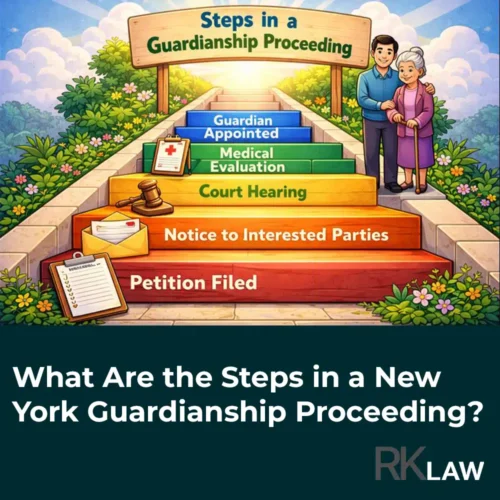
What Are the Steps in a New York Guardianship Proceeding?
When an adult in New York can no longer manage their personal or financial affairs, family members often start to hear the term “Article 81 guardianship.” That’s the section of the New York Mental Hygiene Law (MHL) that governs court-appointed guardians for adults who are found to be incapacitated.
This post walks you through the typical steps in a New York Article 81 guardianship proceeding, from the first red flags to what happens after a guardian is appointed.
What Is an Article 81 Guardianship and What are The Steps in a New York Guardianship Proceeding?
Under MHL Article 81, a New York court can appoint a guardian to make personal needs and/or property management decisions for an adult who, because of incapacity, cannot adequately understand and appreciate the nature and consequences of those decisions.
Key features of Article 81 guardianships:
- The guardian’s powers must be “least restrictive” and tailored to the person’s functional limitations – not a blanket loss of all rights.
- The court focuses on the person’s ability to manage activities of daily living and finances, not just a diagnosis.
- The person at the center of the case is called the alleged incapacitated person (AIP) until the court makes a finding.
Step 1 of Steps in a New York Guardianship Proceeding: Recognize the Problem and Consider Alternatives
Guardianship is considered a last resort in New York. It should only be pursued when less restrictive options are not sufficient to protect the person.
Before filing, families should consider whether any of these tools adequately protect the person:
- Valid power of attorney for finances
- Health care proxy or medical power of attorney
- Representative payee for Social Security or pensions
- Trusts, joint accounts, or other financial arrangements
- Supportive services at home or in the community
If these tools are missing, outdated, being abused, or if the person is too compromised to sign new documents, an Article 81 guardianship may be necessary.
Step 2: Consult a New York Guardianship Attorney
Guardianship cases are legally and emotionally complicated. Petitioners often benefit from working with a New York attorney who regularly handles Article 81 matters and understands:
- The exact statutory requirements under MHL Article 81
- Local court practices in New York City, Long Island, and surrounding counties
- How to structure the request so it is narrowly tailored to the person’s needs
An attorney will help you evaluate whether guardianship is appropriate and what type of guardian (personal needs, property, or both) makes sense.
Step 3 of Steps in a New York Guardianship Proceeding: Filing the Petition and Order to Show Cause
To start a guardianship case, a petition and an Order to Show Cause are filed in the appropriate court (usually New York Supreme Court; in some counties, County Court).
The petitioner can be:
- A family member
- A friend or concerned person
- Certain agencies (for example, hospitals or social service agencies)
The petition typically includes:
- The AIP’s identity, age, and residence
- The petitioner’s relationship to the AIP
- Specific facts showing functional limitations (missed medications, unpaid bills, wandering, exploitation, etc.)
- A description of the AIP’s property and income
- The powers requested for the guardian (healthcare, placement, bill payment, sale of property, etc.)
- Any known alternatives to guardianship that were tried or considered
The judge signs an Order to Show Cause that:
- Schedules the hearing date and time
- Appoints a court evaluator (and sometimes counsel)
- Specifies who must receive notice and how
Step 4: Appointment of Court Evaluator and Counsel
The court will appoint a court evaluator, a neutral person (often an attorney) who acts as the “eyes and ears” of the court.
The evaluator’s role usually includes:
- Meeting with the AIP
- Interviewing family members, caregivers, and professionals
- Reviewing medical records, financial records, and living conditions
- Exploring less restrictive alternatives
- Preparing a written report and recommendation to the court
In many cases, the court will also appoint an attorney for the AIP if the AIP does not retain one or is unable to do so.
If there is an emergency—such as imminent risk of physical harm or financial exploitation—the court can appoint a temporary guardian with limited powers pending the full hearing.
Step 5 of Steps in a New York Guardianship Proceeding: Notice and Service
The petitioner must ensure proper service of:
- The Order to Show Cause
- The petition
- Any other documents required by the court
These must be served on:
- The AIP
- Certain close relatives (spouse, adult children, parents, etc., depending on the case)
- Other interested parties identified in the order (for example, facility, agency, prior agents)
Proper service and notice are critical. They protect due process rights and can affect whether the court can proceed.
Step 6 of Steps in a New York Guardianship Proceeding: The Guardianship Hearing
At the guardianship hearing, the judge decides whether:
- The AIP is incapacitated under Article 81, and
- A guardian is necessary and appropriate as the least restrictive form of intervention.
Key features of the hearing:
- The AIP has the right to be present, to testify, and to cross-examine witnesses (through counsel).
- The petitioner presents testimony and evidence about the AIP’s functional limitations, risks, and finances.
- The court evaluator may testify and is often subject to cross-examination.
- Witnesses may testify for either side.
The petitioner generally must prove by clear and convincing evidence that the AIP is incapacitated and that guardianship is needed.
Step 7: The Court’s Decision & Appointment of a Guardian
After hearing the evidence, the judge may:
- Dismiss the petition
- Deny guardianship but recommend or order less restrictive measures
- Appoint a guardian, specifying:
- Who will serve (family member, professional, community guardian agency, etc.)
- Whether the guardian is for personal needs, property management, or both
- The exact powers granted (consent to medical care, pay bills, manage investments, apply for benefits, change residence, and so on)
- Who will serve (family member, professional, community guardian agency, etc.)
The decision is formalized in an Order and Judgment.
Step 8: Guardian Qualification, Training, and Commission
A guardian cannot act until they complete qualification steps, which may include:
- Signing and filing an oath and designation
- Obtaining a bond (insurance) if required by the court
- Completing a mandatory guardianship training class approved by the court system
- Filing any required initial documents with the guardianship clerk
Once these steps are completed, the guardian receives a commission, which is the formal document authorizing them to act on the AIP’s behalf.
Step 9 of Steps in a New York Guardianship Proceeding: Guardian’s Ongoing Duties and Reporting
After appointment, Article 81 guardians must:
- Act as a fiduciary—in the best interests of the incapacitated person
- Use the least restrictive means consistent with the person’s welfare
- Maintain careful records of all income, expenses, and decisions
Reporting requirements typically include:
- An Initial Report (often within 90 days) describing the person’s condition, services, and plans
- Annual reports/accountings on both personal and financial matters, which are reviewed by a court examiner and the court
Failure to report can lead to court sanctions or removal.
Steps in a New York Guardianship Proceeding – How Long Does an Article 81 Guardianship Case Take in New York?
Timeframes vary based on:
- The urgency of the situation
- Court calendar and backlog
- Whether the case is contested
- How quickly documents and evaluations are completed
Some emergency cases move quickly, with a temporary guardian appointed, while fully contested cases with extensive discovery can take significantly longer.
Frequently Asked Questions About Steps in a New York Guardianship Proceeding
Any person over 18 or certain entities (such as hospitals, nursing homes, or social service agencies) can file a petition if they believe an adult needs a guardian. Family members—such as spouses, adult children, and siblings—are common petitioners.
Petitions are usually filed in New York Supreme Court (or, in some counties, County Court) in the county where the AIP resides or is physically present.
The court looks at:
The person’s ability to manage activities of daily living
Their ability to manage property and financial affairs
The existence of harm or risk of harm and whether it can be prevented by less restrictive alternatives
Incapacity is generally proven by clear and convincing evidence.
You are not legally required to have a lawyer to file, and there are basic court resources for self-represented litigants. However, Article 81 cases involve complex legal standards, evidence, and ongoing obligations. Most petitioners, and many proposed guardians, find that working with a New York guardianship attorney helps avoid costly mistakes and delays.
Not necessarily. A guardianship can:
Be modified (powers increased or reduced)
Be terminated if the person’s condition improves or circumstances change
End upon the death of the incapacitated person
The court retains continuing jurisdiction to review and adjust guardianship orders.
Article 81 (MHL) is typically used for adults whose incapacity arises from illness, dementia, stroke, or injury. It is functional and tailored: the court grants only the powers needed.
SCPA 17-A (Surrogate’s Court Procedure Act) is usually used for individuals with developmental or intellectual disabilities and tends to be more “plenary” (broad).
Choosing the correct type of guardianship is critical and should be discussed with counsel.
Costs vary widely and can include:
Court filing fees
Process server fees
Fees for the court evaluator and any court-appointed counsel
Attorney’s fees for the petitioner and, in some cases, the AIP
Ongoing costs of administration and reporting
In many cases, the court may authorize payment of fees from the AIP’s assets, subject to review and approval.
Yes. The court can appoint:
Co-guardians who act together
Different guardians for personal needs and property management
A successor guardian to step in if the original guardian can no longer serve
How RK Law PC Can Help With The Steps in a New York Guardianship Proceeding
At RK Law PC, we regularly represent:
- Family members seeking to protect a vulnerable loved one
- Alleged incapacitated persons who wish to oppose or limit guardianship
- Proposed guardians and existing guardians who need guidance on their duties
We can help you:
- Determine whether guardianship is appropriate
- Prepare and file the petition and supporting papers
- Navigate court evaluators, hearing preparation, and testimony
- Understand your ongoing obligations if you are appointed as guardian
If you’re concerned about a loved one in New York and think guardianship might be necessary, you can reach out through our website at rklawny.com to schedule a consultation.
For more information, please contact NYC Probate Litigation, Guardianship, Probate, and Estate Planning attorney Regina Kiperman:

Phone: 917-261-4514
Fax: 929-556-2089
Email: rkiperman@rklawny.com
Or visit her at:
40 Wall Street
Suite 2508
New York, NY 10005
Visit Regina on LinkedIn
Visit Regina on Facebook
This page is made available by the lawyer for educational purposes only as well as to give you general information and a general understanding of the law, not to provide specific legal advice. By using this site you understand that there is no attorney client relationship between you and the lawyer. The post should not be used as a substitute for competent legal advice from a licensed professional attorney in your state. ATTORNEY ADVERTISING.
The structure will depend on what best protects the incapacitated person while preserving as much independence as possible.